
The Evolution of CRM with AI
In the previous edition, CRM as the Control Plane, the argument was that automation only scales when CRM is treated as the place where decisions become binding, not where work happens.
AI pushes that idea further.
Because once large language models enter the stack, the question is no longer “what should we automate?” It becomes “what should the system be able to explain for us?”
Disclosure: Certain tools mentioned may be used in my professional work, but I have no paid endorsements, sponsorships, or financial arrangements with the vendors.

Transformations in CRM Systems
What AI actually changes inside CRM systems
AI becomes valuable in CRM when it sits between raw signals and execution, using LLMs to interpret context before anything is written, moved, or triggered.
That interpretation layer is already emerging across the stack.
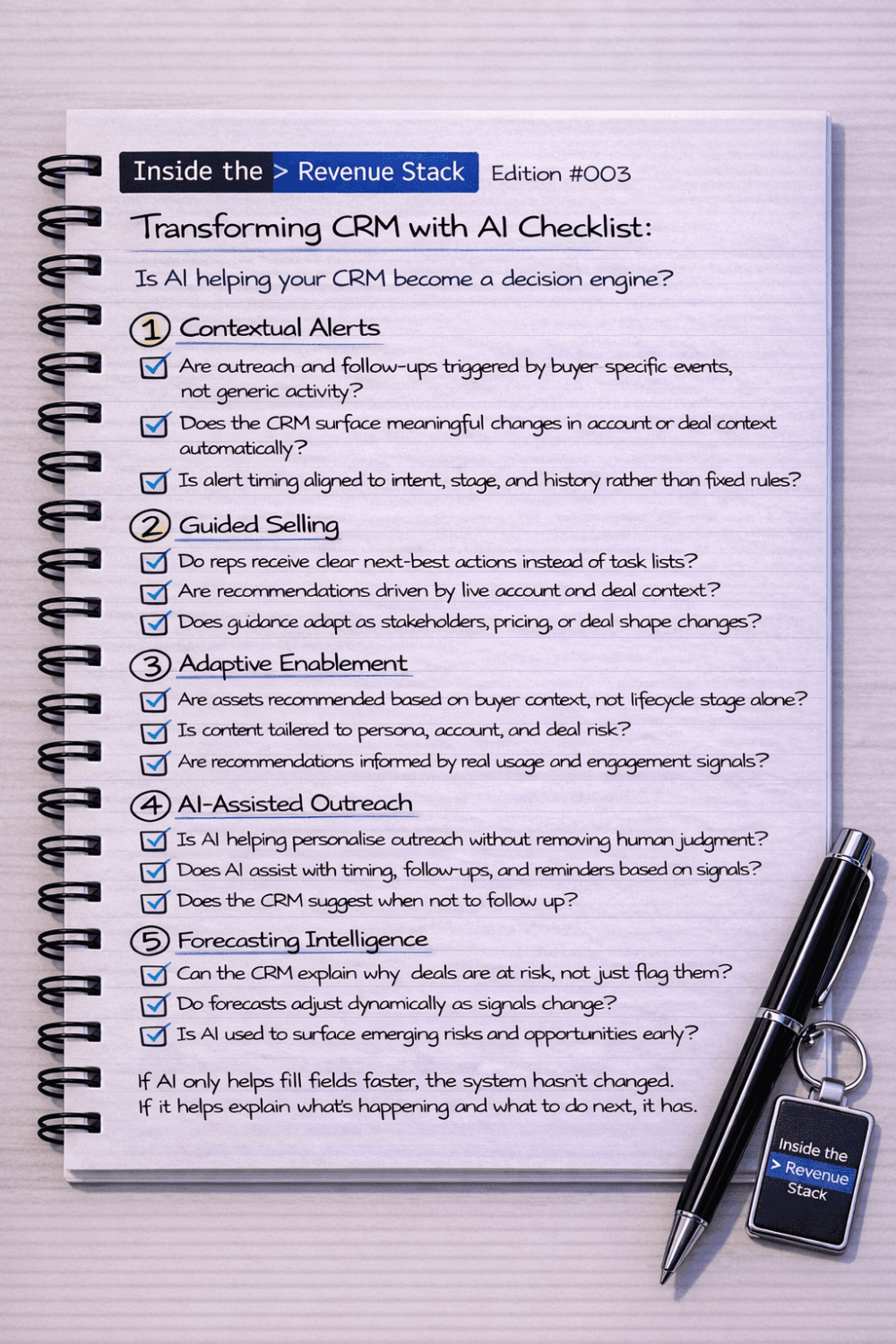
1. CRM + LLMs: from fields to context
Modern CRMs are starting to embed LLMs to reason over activity, not just store it.
Instead of asking reps to fill fields, systems can now:
summarise what changed since the last interaction
explain why a deal’s risk profile shifted
surface inconsistencies across notes, emails, and calls
Native capabilities in platforms like HubSpot and Salesforce are moving in this direction, and many teams are also layering general-purpose LLMs on top of CRM data to generate account and deal narratives.
The practical shift is this: CRM stops asking for declarations and starts offering explanations.
2. Call intelligence becomes deal intelligence
Conversation intelligence is one of the clearest examples of LLMs adding real value.
Tools like Gong and Chorus are no longer just recording calls. LLMs are now:
extracting objections and decision criteria
tracking how urgency and sentiment evolve over time
identifying when buyer behaviour diverges from what’s being said
That output feeds back into CRM as interpreted context, not raw transcripts.
This is where deals stop being collections of activities and start becoming something the system can reason about.
3. Enablement driven by context, not stages
Enablement is another area where LLMs quietly change behaviour.
Instead of reps choosing from large content libraries, AI-driven enablement platforms can:
recommend the right asset for this buyer and moment
adapt messaging based on persona, industry, or tone
reduce content overload by filtering rather than expanding
Platforms like Highspot and Seismic are increasingly using LLMs to remove decision fatigue, not add more options.
Good enablement doesn’t make people smarter. It removes unnecessary choices.
4. AI-assisted outreach and follow-up
LLMs also change outbound and follow-up when they’re grounded in real context.
Modern sales engagement tools are starting to use LLMs to:
personalise messages based on live account signals
adapt follow-ups based on buyer behaviour
recommend when not to follow up at all
The value isn’t scale for its own sake. It’s relevance without manual effort.
5. RevOps and forecasting: from reports to reasoning
This is where AI has the biggest impact for RevOps.
Instead of producing dashboards that need interpretation, LLMs can now:
explain forecast movement
highlight where pipeline risk is emerging
translate operational data into executive language
Platforms like Clari and LeanData increasingly act as reasoning layers, helping teams understand why numbers changed, not just that they did.
This is where RevOps moves from reporting outcomes to shaping decisions.

Why CRM still has to be the control plane ✈️
LLMs can reason across systems. They should not execute decisions everywhere.
If every tool explains reality differently, trust erodes. If automation fires without clear thresholds, confidence collapses.
CRM remains the control plane:
where intent is confirmed
where lifecycle state changes
where ownership is enforced
where automation is allowed to act
AI should explain broadly. CRM should decide narrowly.
That boundary is what keeps AI useful rather than destabilising.
A practical test for any AI or LLM capability
Before enabling an AI feature, ask:
Is this helping the system explain what’s happening, or is it trying to decide what should happen?
If it’s deciding:
what decision is it making?
is that decision actually clear at this point?
who owns the outcome if it’s wrong?
If those answers aren’t obvious, the AI is probably acting too early.

More AI