
The Myth of the Single Source of Truth
This edition of Inside the Revenue Stack builds on the ideas from the previous three:
A HubSpot Deployment is Not a Project. It’s an Operating Mode
CRM as the 'Control Plane': Designing Automation That Scales in SaaS
When AI Turns CRM Into a System That Explains Itself
The next logical step is this: truth does not need to be centralised to be useful. Decisions do.
Why modern revenue systems need decision engines, not museums
“Single Source of Truth” is one of the most repeated phrases in CRM, RevOps, and digital transformation conversations.
It’s also one of the most misleading.
Most organisations don’t struggle because they lack a single source of truth. They struggle because they optimise for perfect consolidation instead of timely decision-making. The outcome is familiar: data that is technically accurate, but operationally late.
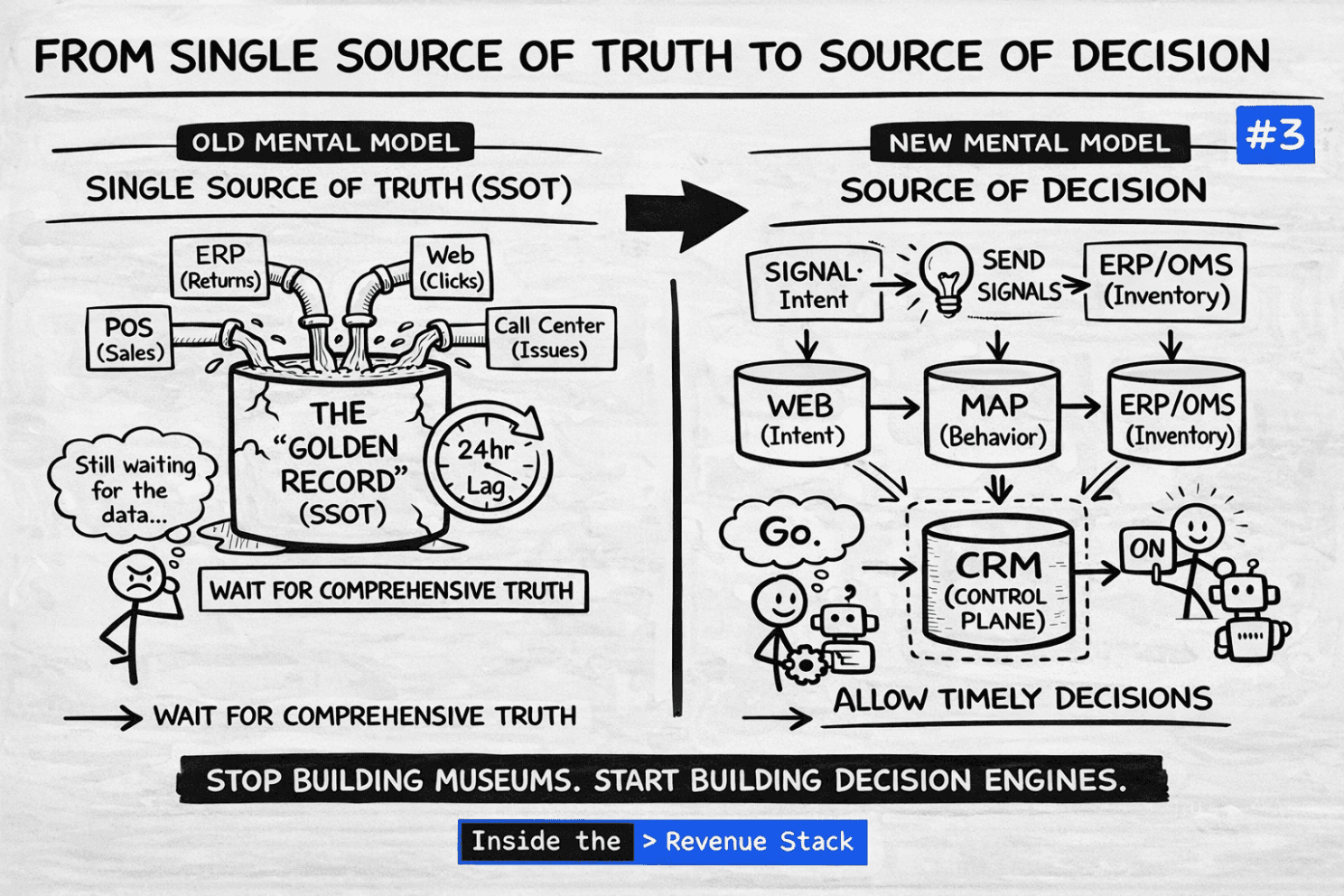
The promise of the “golden record”
The traditional SSOT model assumes that if every system feeds into one canonical record, clarity will follow.
Sales feeds CRM. Marketing feeds attribution. Product feeds analytics. Finance feeds ERP.
Everything flows into a single “golden record”.
Article content
In theory, this creates alignment and confidence. In practice, it creates latency.
By the time the record is complete, reconciled, and “safe to use”, the moment to act has often passed. Teams wait for downstream updates, overnight syncs, and validation cycles. Decisions are delayed not because data is missing, but because perfection is being enforced.
This is how CRM quietly turns into a museum: a well-curated history of what already happened.

Timing Matters More Than Perfection
The real problem isn’t accuracy. It’s timing.
Most GTM decisions don’t require perfect truth. They require sufficient accuracy at the right moment.
A seller needs to know intent now. An ops team needs to know risk now. A system needs to know whether to act now.
When everything is forced through a single record, speed is traded for completeness. Data becomes technically correct but operationally stale.
This is where the SSOT mental model starts to work against execution.
Reality: truth is already distributed
In modern SaaS and GTM stacks, truth already exists in multiple places.
Web platforms hold intent. Product systems hold behaviour. ERP holds inventory, billing, and fulfilment reality. CRM holds lifecycle state, ownership, and accountability.
Each system has local truth, valid within its own domain and timeframe.
Article content
The goal is not to collapse all truth into one place. The goal is to orchestrate decisions across systems without waiting for perfect consolidation.
Speed beats completeness when decisions are reversible. Completeness matters when decisions become binding.

From Source of Truth to Source of Decision
From “single source of truth” to “source of decision”
What matters operationally isn’t where data lives. It’s where decisions are allowed to become binding.
This is where CRM still plays a critical role.
CRM should not try to be the source of every truth. Instead, it should act as the control plane, where:
signals are reconciled
intent is confirmed
lifecycle state is changed
ownership is enforced
automation is allowed to execute
Article content
Other systems remain authoritative for their domains. CRM’s role is to decide when something matters enough to change state and trigger action.
This reframes CRM from a passive database into an active decision layer.
Why this matters for automation and AI
As automation and AI mature, the SSOT mindset becomes actively dangerous.
AI does not need perfect data. It needs context, thresholds, and permission to act.
When teams wait for the golden record, automation stalls. When distributed signals are reconciled through a control plane, automation accelerates without losing trust.
This is the difference between:
systems that observe endlessly
and systems that act deliberately
The real shift
The shift isn’t from bad data to good data. It’s from data collection to decision architecture.
Stop building systems optimised for historical accuracy. Start building systems optimised for timely, auditable decisions.
Or more simply:
Stop building museums. Start building decision engines.

More General