
The System Beneath the Pipeline
Designing Revenue Architecture in HubSpot
1. The Pipeline Is Only the Surface
Many organisations implement HubSpot expecting it to function as their revenue engine.
Open the CRM and the structure appears clear. Contacts enter the system, deals move through pipeline stages and dashboards track performance across the funnel. For many teams this visibility creates the impression that revenue is now structured and measurable.
But the pipeline itself does not drive revenue.
It simply visualises it.
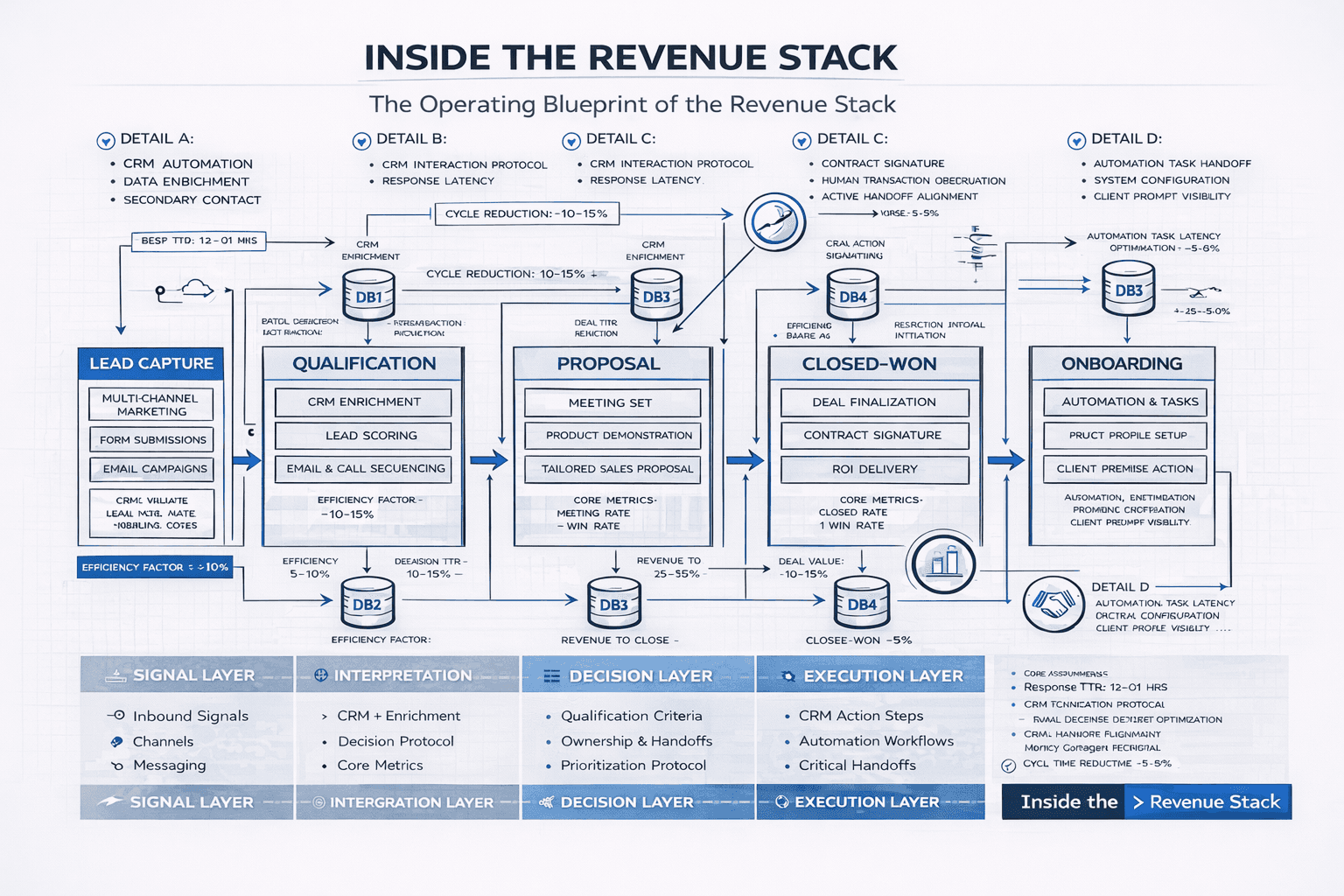
What actually determines whether opportunities progress inside HubSpot sits beneath the pipeline - a system that captures signals, interprets behaviour, supports decisions and coordinates execution across marketing, sales and operations.
When HubSpot is implemented only as a pipeline tracker, it becomes a reporting interface. When it is designed as a revenue operating system, it becomes the environment where the entire commercial architecture operates.
Understanding that difference is what separates a basic CRM deployment from a functioning revenue system.

2. Capturing Signals and Structuring Decisions
Every revenue system begins with signals.
In HubSpot these signals appear across the customer journey through website activity, inbound forms, marketing campaigns, email engagement and outbound responses. HubSpot captures these interactions and attaches them to contact and company records, allowing organisations to track behaviour as it unfolds.
However, raw activity alone rarely provides meaningful context. A form submission or website visit does not automatically represent a real opportunity.
HubSpot’s data model allows organisations to interpret these signals through lifecycle stages, contact properties, lead scoring models and behavioural tracking. These mechanisms help distinguish between casual engagement and genuine buying intent.
Once signals have been interpreted, HubSpot’s pipeline architecture begins structuring commercial decisions. Deals are created, ownership is assigned and qualification criteria determine whether opportunities progress through the pipeline.
At this stage, the CRM stops acting as a passive database and begins functioning as a decision system. Workflows enforce qualification rules, automate assignment and ensure opportunities move forward according to structured criteria.
When this layer is designed intentionally, HubSpot becomes the place where commercial decisions are captured, coordinated and made visible across the organisation.

3. Executing Revenue Across the Customer Lifecycle
The final layer of the revenue system is execution.
Once opportunities progress through the pipeline and deals are closed, the system must coordinate the operational activities required to deliver value to the customer. HubSpot workflows automate internal tasks, manage customer onboarding processes and coordinate handoffs between sales, customer success and operations.
Execution is where the revenue architecture moves from planning to action.
When execution is slow or fragmented, customer momentum is lost and operational friction appears quickly. When workflows and ownership models are well designed, teams respond faster and the transition from sales to delivery becomes seamless.
In this sense, HubSpot functions as the control plane of the revenue stack. It connects marketing signals, sales decisions and operational execution into a coordinated system.
The pipeline is therefore not the engine of revenue.
It is the dashboard.
The real engine is the system beneath it - the architecture that captures signals, interprets intent, structures decisions and executes activity across the entire customer lifecycle.

More Deployment
